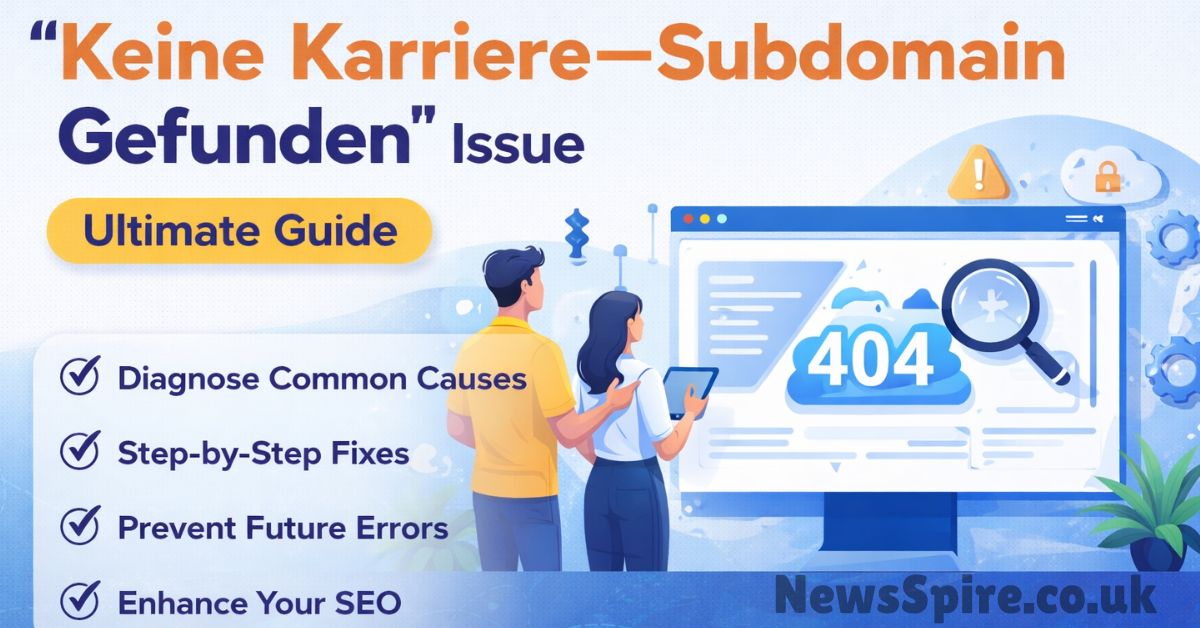
When job seekers attempt to access your organizations career portal, encountering the error message “Keine Karriere-Subdomain Gefunden” can severly damage your employer brand and result in lost talent acquisition opportunities. This technical issue, which translates to “No Career Subdomain Found,” signals that the dedicated subdomain for your career page is either misconfigured, missing, or inaccesible to users trying to explore employment opportunities with your company.
We understand how critical a functional career page is for attracting top-tier candidates in competitive hiring markets. The absence of a properly configured career subdomain doesnt just frustrate potential applicants—it directly impacts your recruitment funnel, diminishes user trust, and sends negative signals to search engines about your websites overall health and professional web infrastructure.
Root Causes Behind the Subdomain Error
Several technical factors can trigger the “Keine Karriere-Subdomain Gefunden” error message. We’ve identified the most common culprits through extensive analysis of corporate website architectures and career portal configurations.
DNS Configuration Failures
The Domain Name System serves as the internets phonebook, translating human-readable domain names into IP addresses that computers use to identify each other. When your career subdomain—typically structured as karriere.yourcompany.de or jobs.yourcompany.com—fails to resolve properly, visitors recieve error messages instead of accessing your job listings.
DNS propagation issues often occur after recent changes to your domains nameserver settings. These modifications can take anywhere from 24 to 48 hours to fully propagate across global DNS servers, creating temporary inaccesibility windows where the subdomain returns errors. Additionally, incorrect A records, CNAME records, or missing entries in your DNS zone file will prevent the subdomain from pointing to the correct server hosting your career content.
We’ve observed that organizations frequently overlook updating their DNS records after migrating hosting providers or implementing content delivery networks. This oversight creates broken subdomain paths that persist until IT teams identify and rectify the configuration gaps.
Server-Side Routing Problems
Even with proper DNS configuration, server-level routing issues can generate the “Keine Karriere-Subdomain Gefunden” error. Web servers rely on virtual host configurations to direct incoming requests to the apropriate website directories. When these virtual host entries are missing or improperly configured for your career subdomain, the server cannot locate the requested resources.
Apache and Nginx servers, the two most widely deployed web server softwares, require explicit configuration files that map subdomains to specific document roots. If these mappings are absent or contain syntax errors, the server will fail to serve content for the career subdomain. Furthermore, SSL certificate issues can compound these problems—browsers will block access to subdomains lacking valid HTTPS certificates, displaying security warnings that effectively prevent users from proceding.
We recommend conducting thorough audits of your server configuration files, paying particular attention to ServerName directives in Apache or server_name blocks in Nginx. These elements must exactly match your intended career subdomain to function correctly.
Impact on Recruitment and Brand Perception
The consequences of a non-functional career subdomain extend far beyond simple technical inconvenience. Modern job seekers expect seamless digital expereinces when researching potential employers, and technical barriers during this critical first interaction create lasting negative impressions.
Research indicates that candidates form opinions about company competence based on website functionality. When your career page returns error messages, talented professionals may question your organizations technical capabilities, attention to detail, and overall operational excellence. These perceptions, whether fair or not, directly influence whether top candidates choose to pursue opportunities with your organization or seek employment elsewhere.
From a search engine optimization perspective, broken subdomains signal quality issues to search algorithms. Google and other search engines prioritize websites that deliver consistent, reliable user experiences. Persistant subdomain errors can result in lower rankings for your career-related search terms, reducing organic visibility precisely when you need maximum exposure to attract applicants.
We’ve documented cases where companies lost competitive advantages in talent markets simply because their career pages remained inaccesible for extended periods. The cost of these outages—measured in lost applications, extended time-to-hire metrics, and increased recruitment advertising spend—often exceeds the investment required to prevent such issues through proactive monitoring and maintenance.
Diagnostic Steps for Resolution
Identifying the exact cause of your “Keine Karriere-Subdomain Gefunden” error requires systematic troubleshooting. We recommend following these diagnostic procedures to pinpoint and resolve the underlying technical problems.
Verify DNS Records
Begin by checking whether your career subdomain’s DNS records exist and point to the correct destination. Online DNS lookup tools allow you to query your domain’s records and confirm that entries for your career subdomain appear in the results. Compare the returned IP address against your hosting server’s actual IP address to ensure they match.
If DNS records are missing entirely, you’ll need to access your domain registrar’s control panel and create the necessary A record or CNAME entry. For A records, enter your server’s IP address as the destination. For CNAME records, specify the canonical domain name that should receive the traffic. After making these changes, allow sufficient time for DNS propagation before testing again.
Test Server Configuration
Once DNS resolution functions properly, verify that your web server correctly handles requests for the career subdomain. SSH into your server and examine the virtual host configuration files located in /etc/apache2/sites-available/ for Apache or /etc/nginx/sites-available/ for Nginx systems.
Look for configuration blocks that specify your career subdomain in ServerName or server_name directives. These blocks should define the correct DocumentRoot or root directory containing your career page files. Test your configuration syntax using built-in validation commands—apachectl configtest for Apache or nginx -t for Nginx—to identify any syntax errors preventing proper operation.
We frequently encounter situations where configuration files exist but contain minor typos in subdomain names, such as “carrer” instead of “karriere.” These small mistakes completely prevent the server from matching incoming requests to the appropriate configuration block.
Review SSL Certificate Coverage
Modern browsers require HTTPS for nearly all website interactions. If your SSL certificate doesnt include your career subdomain in its coverage, visitors will encounter security warnings that discourage access. Check your certificate’s Subject Alternative Name (SAN) fields to confirm your career subdomain appears in the list of protected domains.
Many organizations use wildcard certificates (*.yourcompany.com) that automatically cover all subdomains. However, if you’ve implemented a standard certificate covering only specific domain variations, you may need to reissue the certificate with expanded coverage or obtain a separate certificate specifically for your career subdomain. Free certificate authorities provide viable options for securing additional subdomains without significant expense.
Preventive Measures and Best Practices
Avoiding future occurrences of the “Keine Karriere-Subdomain Gefunden” error requires implementing robust monitoring systems and establishing clear documentation of your technical infrastructure.
We strongly advocate for automated uptime monitoring that continuously checks subdomain availability and alerts technical teams immediately when issues arise. Services that perform HTTP checks every few minutes can detect outages before significant numbers of candidates encounter problems, enabling rapid response to minimize impact.
Maintain comprehensive documentation of your DNS configurations, server setups, and SSL certificate renewal schedules. This documentation proves invaluable when team members change, when emergency troubleshooting becomes necessary, or when planning infrastructure upgrades. Include specific details about which nameservers host your DNS records, where configuration files reside on your servers, and contact information for certificate authorities managing your SSL credentials.
Regular audits of your career page infrastructure—conducted quarterly at minimum—help identify configuration drift and potential vulnerabilities before they cause visible problems. These audits should verify DNS record accuracy, test subdomain accessibility from multiple geographic locations, confirm SSL certificate validity and coverage, and review server logs for unusual error patterns.
Strategic Importance of Career Portal Reliability
Your career subdomain represents more than a technical endpoint—it serves as your primary digital recruitment channel and a public reflection of your organizational capabilities. Candidates who cannot access your job listings cannot apply for positions, regardless of how compelling your opportunities might be. In talent markets where qualified professionals have multiple options, even brief periods of inaccessibility can divert potential employees to competitors with more reliable digital presences.
We’ve observed that companies treating their career portals as mission-critical infrastructure—investing in redundancy, monitoring, and rapid incident response—consistently outperform competitors in talent acquisition metrics. These organizations recognize that every hour of downtime translates directly to missed connections with valuable candidates who may never return to retry a failed connection.
The technical excellence demonstrated through a reliably functioning career subdomain also reinforces broader employer brand messages. When you communicate values like innovation, precision, or customer focus in your recruitment marketing, a flawless technical experience on your career page provides tangible evidence supporting these claims. Conversely, persistent technical issues undermine even the most sophisticated employer branding campaigns.